Mastering Google Ads Banners: A Guide to Editable Design Templates
Capturing attention in the crowded digital advertising space requires more than just a catchy headline; it demands a visual strategy that stops the scroll. For designers, marketers, and small business owners, creating high-performing display ads from scratch is a time-consuming process. This is where the utility of a robust Google Ads Banner Design Template becomes undeniable. These templates provide a structural foundation, allowing you to focus on the creative nuances of your specific campaign rather than wrestling with pixel dimensions and layout grids from the ground up. By utilizing a layer organized file, you gain immediate access to a professional framework designed to convert.
The Anatomy of an Effective Ad Template
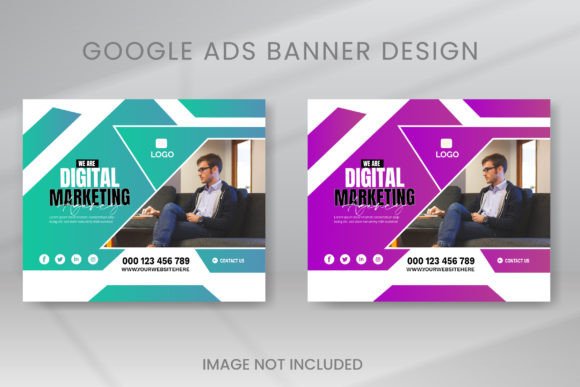
A high-quality Google Ads Banner Design Template is defined by its visual personality and structural integrity. These assets are not just static images; they are dynamic design assets built with versatility in mind. Typically, a trendy creative editable template features a clean, modern aesthetic that balances negative space with bold typography. The visual characteristics often lean towards a minimalist style, ensuring that the message remains the focal point. This approach aligns with modern typography principles where clarity is prioritized over ornamentation.
The appeal of these templates lies in their adaptability. Whether you are promoting a flash sale, a new product launch, or a corporate service, the underlying structure supports various visual weights. You might encounter layouts that favor a strong display font for the headline, paired with a highly legible sans serif font for the call-to-action. This combination creates a visual hierarchy that guides the viewer's eye naturally from the hook to the offer. For brands looking to inject personality, some templates incorporate areas for script font or handwritten font elements, adding a touch of warmth and authenticity to the digital canvas.
Strategic Applications Across Industries
The versatility of a well-crafted Google Ads Banner Design Template extends far beyond simple text replacement. For entrepreneurs and small business owners, these files serve as a bridge to professional-grade advertising without the overhead of a full creative agency. A creative font choice within the template can instantly elevate a startup’s brand identity, signaling credibility to a new audience. In the realm of social media graphics, these templates ensure that your visual language remains consistent across platforms, reinforcing brand recognition.
For designers and content creators, the value lies in efficiency. When managing multiple client campaigns, having a library of editable and customizable files allows for rapid prototyping and deployment. Imagine a scenario where a client in the fashion industry needs a set of ads for a seasonal collection. A template featuring elegant lines and space for high-contrast imagery—perhaps styled with a sophisticated serif font—can be adapted in minutes. Similarly, a tech startup might require a template that feels futuristic and clean, utilizing geometric shapes and a sharp sans serif font to convey innovation. The ability to easily change and fit business specifications means one template can serve vastly different industries, from packaging design visuals to web design promotions.
Customization: The Power of the AI File
The true power of these resources lies in the file format. Included as an AI File (Adobe Illustrator), the template offers full vector scalability. This is crucial for editorial design and logo design integration, ensuring that your brand assets remain crisp regardless of the ad size. Unlike flattened image files, an AI file allows you to dissect the design. You can adjust kerning, swap color palettes, and manipulate shapes to fit your specific visual strategy.
However, it is vital to address the technical aspects of customization. The prompt notes that image is not included and that all images are used for preview purposes only. This is a standard practice in the world of premium font and template distribution due to licensing restrictions on stock photography. For the end-user, this means you must source your own high-resolution photography or illustrations. This requirement actually benefits the final output; it forces you to use original, on-brand imagery rather than generic stock photos, which can often dilute a campaign's effectiveness. When selecting your images, consider how they interact with the typography. A busy background might require a semi-transparent overlay to ensure a serif font or sans serif font remains legible.
Evaluating Fit and Ensuring Readability
Choosing the right Google Ads Banner Design Template requires a critical eye. Do not simply select a design based on its standalone beauty; evaluate it based on your campaign's specific needs. Consider the font pairing used in the preview. Does the combination of a bold header typeface and a subtle body text create the right mood? A mismatch in typography can confuse the viewer. For instance, pairing a playful handwritten font with a rigid, technical sans serif font might work for a creative software company but could look disjointed for a luxury law firm.
Readability is paramount in advertising. Even the most trendy creative design fails if the message cannot be read at a glance. Test the layout's "squint test"—if you squint at the design, can you still identify the headline and the offer? The layer organized file should make it easy to adjust text sizes. If the default display font is too decorative, swap it for a cleaner modern typography option that ensures legibility across different screen resolutions, particularly on mobile devices where most digital ads are consumed.
Practical Workflow for Designers and Marketers
To maximize the potential of these design assets, establish a streamlined workflow. Begin by reviewing the full template package. While the focus is often on the visual layout, check for consistency in style across different banner sizes (e.g., leaderboard, skyscraper, rectangle). A cohesive set ensures your brand identity is recognizable whether the ad appears on a sidebar or a header.
Next, focus on the content hierarchy. Use the template’s grid to structure your message. Place your most compelling value proposition in the primary visual weight area, usually reserved for the largest creative font. Follow this with supporting details and a clear Call to Action (CTA). The CTA button design within the template is often customizable; ensure it contrasts sharply with the background to draw the eye. Finally, when exporting, double-check that all typography—whether it is a premium font you purchased or a standard system font—is outlined or embedded correctly to prevent rendering issues across different devices. By treating the template as a flexible starting point rather than a rigid final product, you can produce high-converting Google Ads that look custom-made for your business.